pbcore.io.dataset
The Python DataSet XML API is designed to be a lightweight interface for creating, opening, manipulating and writing DataSet XML files. It provides both a native Python API and console entry points for use in manual dataset curation or as a resource for P_Module developers.
The API and console entry points are designed with the set operations one might perform on the various types of data held by a DataSet XML in mind: merge, split, write etc. While various types of DataSets can be found in XML files, the API (and in a way the console entry point, dataset.py) has DataSet as its base type, with various subtypes extending or replacing functionality as needed.
Console Entry Point Usage
The following entry points are available through the main script: dataset.py:
usage: dataset.py [-h] [-v] [--debug]
                  {create,filter,merge,split,validate,loadstats,consolidate}
                  ...

Run dataset.py by specifying a command.

optional arguments:
  -h, --help            show this help message and exit
  -v, --version         show program's version number and exit
  --debug               Turn on debug level logging

DataSet sub-commands:
  {create,filter,merge,split,validate,loadstats,consolidate}
                        Type {command} -h for a command's options
Create:
usage: dataset.py create [-h] [--type DSTYPE] [--novalidate] [--relative]
                         outfile infile [infile ...]

Create an XML file from a fofn or bam

positional arguments:
  outfile        The XML to create
  infile         The fofn or BAM file(s) to make into an XML

optional arguments:
  -h, --help     show this help message and exit
  --type DSTYPE  The type of XML to create
  --novalidate   Don't validate the resulting XML, don't touch paths
  --relative     Make the included paths relative instead of absolute (not
                 compatible with --novalidate)
Filter:
usage: dataset.py filter [-h] infile outfile filters [filters ...]

Add filters to an XML file. Suggested fields: ['bcf', 'bcq', 'bcr',
'length', 'pos', 'qend', 'qname', 'qstart', 'readstart', 'rname', 'rq',
'tend', 'tstart', 'zm']. More expensive fields: ['accuracy', 'bc', 'movie',
'qs']

positional arguments:
  infile      The xml file to filter
  outfile     The resulting xml file
  filters     The values and thresholds to filter (e.g. 'rq>0.85')

optional arguments:
  -h, --help  show this help message and exit
Union:
usage: dataset.py union [-h] outfile infiles [infiles ...]

Combine XML (and BAM) files

positional arguments:
  outfile     The resulting XML file
  infiles     The XML files to merge

optional arguments:
  -h, --help  show this help message and exit
Validate:
usage: dataset.py validate [-h] infile

Validate ResourceId files (XML validation only available in testing)

positional arguments:
  infile      The XML file to validate

optional arguments:
  -h, --help  show this help message and exit
Load PipeStats:
usage: dataset.py loadstats [-h] [--outfile OUTFILE] infile statsfile

Load an sts.xml file into a DataSet XML file

positional arguments:
  infile             The XML file to modify
  statsfile          The .sts.xml file to load

optional arguments:
  -h, --help         show this help message and exit
  --outfile OUTFILE  The XML file to output
Split:
usage: dataset.py split [-h] [--contigs] [--chunks CHUNKS] [--subdatasets]
                        [--outdir OUTDIR]
                        infile ...

Split the dataset

positional arguments:
  infile           The xml file to split
  outfiles         The resulting xml files

optional arguments:
  -h, --help       show this help message and exit
  --contigs        Split on contigs
  --chunks CHUNKS  Split contigs into <chunks> total windows
  --subdatasets    Split on subdatasets
  --outdir OUTDIR  Specify an output directory
Consolidate:
usage: dataset.py consolidate [-h] [--numFiles NUMFILES] [--noTmp]
                              infile datafile xmlfile

Consolidate the XML files

positional arguments:
  infile               The XML file to consolidate
  datafile             The resulting data file
  xmlfile              The resulting XML file

optional arguments:
  -h, --help           show this help message and exit
  --numFiles NUMFILES  The number of data files to produce (1)
  --noTmp              Don't copy to a tmp location to ensure local disk
                       use
Usage Examples
Filter Reads (CLI version)
In this scenario we have one or more bam files worth of subreads, aligned or otherwise, that we want to filter and put in a single bam file. This is possible using the CLI with the following steps, starting with a DataSet XML file:
# usage: dataset.py filter <in_fn.xml> <out_fn.xml> <filters>
dataset.py filter in_fn.subreadset.xml filtered_fn.subreadset.xml 'rq>0.85'

# usage: dataset.py consolidate <in_fn.xml> <out_data_fn.bam> <out_fn.xml>
dataset.py consolidate filtered_fn.subreadset.xml consolidate.subreads.bam out_fn.subreadset.xml
The filtered DataSet and the consolidated DataSet should be read for read equivalent when used with SMRT Analysis software.
Filter Reads (API version)
The API version of filtering allows for more advanced filtering criteria:
ss = SubreadSet('in_fn.subreadset.xml')
ss.filters.addRequirement(rname=[('=', 'E.faecalis.2'),
                                 ('=', 'E.faecalis.2')],
                          tStart=[('<', '99'),
                                  ('<', '299')],
                          tEnd=[('>', '0'),
                                ('>', '200')])
Produces the following conditions for a read to be considered passing:
(rname = E.faecalis.2 AND tstart < 99 AND tend > 0) OR (rname = E.faecalis.2 AND tstart < 299 AND tend > 200)
You can add sets of filters by providing equal length lists of requirements for each filter.
Additional requirements added singly will be added to all filters:
ss.filters.addRequirement(rq=[('>', '0.85')])
(rname = E.faecalis.2 AND tstart < 99 AND tend > 0 AND rq > 0.85) OR (rname = E.faecalis.2 AND tstart < 299 AND tend > 100 AND rq > 0.85)
Additional requirements added with a plurality of options will duplicate the previous requiremnts for each option:
ss.filters.addRequirement(length=[('>', 500), ('>', 1000)])
(rname = E.faecalis.2 AND tstart < 99 AND tend > 0 AND rq > 0.85 AND length > 500) OR (rname = E.faecalis.2 AND tstart < 299 AND tend > 100 AND rq > 0.85 AND length > 500) OR (rname = E.faecalis.2 AND tstart < 99 AND tend > 0 AND rq > 0.85 AND length > 1000) OR (rname = E.faecalis.2 AND tstart < 299 AND tend > 100 AND rq > 0.85 AND length > 1000)
Of course you can always wipe the filters and start over:
ss.filters = None
Consolidation is more similar to the CLI version:
ss.consolidate('cons.bam')
ss.write('cons.xml')
Resequencing Pipeline (CLI version)
In this scenario, we have two movies worth of subreads in two SubreadSets that we want to align to a reference, merge together, split into DataSet chunks by contig, then send through quiver on a chunkwise basis (in parallel).
Align each movie to the reference, producing a dataset with one bam file for each execution:
pbalign movie1.subreadset.xml referenceset.xml movie1.alignmentset.xml
pbalign movie2.subreadset.xml referenceset.xml movie2.alignmentset.xml
Merge the files into a FOFN-like dataset (bams aren’t touched):
# dataset.py merge <out_fn> <in_fn> [<in_fn> <in_fn> ...]
dataset.py merge merged.alignmentset.xml movie1.alignmentset.xml movie2.alignmentset.xml
Split the dataset into chunks by contig (rname) (bams aren’t touched). Note that supplying output files splits the dataset into that many output files (up to the number of contigs), with multiple contigs per file. Not supplying output files splits the dataset into one output file per contig, named automatically. Specifying a number of chunks instead will produce that many files, with contig or even sub contig (reference window) splitting.:
dataset.py split --contigs --chunks 8 merged.alignmentset.xml
Quiver then consumes these chunks:
variantCaller.py --alignmentSetRefWindows --referenceFileName referenceset.xml --outputFilename chunk1consensus.fasta --algorithm quiver chunk1contigs.alignmentset.xml
variantCaller.py --alignmentSetRefWindows --referenceFileName referenceset.xml --outputFilename chunk2consensus.fasta --algorithm quiver chunk2contigs.alignmentset.xml
The chunking works by duplicating the original merged dataset (no bam duplication) and adding filters to each duplicate such that only reads belonging to the appropriate contigs are emitted. The contigs are distributed amongst the output files in such a way that the total number of records per chunk is about even.
Tangential Information
DataSet.refNames (which returns a list of reference names available in the dataset) is also subject to the filtering imposed during the split. Therefore you wont be running through superfluous (and apparently unsampled) contigs to get the reads in this chunk. The DataSet.records generator is also subject to filtering, but not as efficiently as readsInRange. If you do not have a reference window, readsInReference() is also an option.
As the bam files are never touched, each dataset contains all the information necessary to access all reads for all contigs. Doing so on these filtered datasets would require disabling the filters first:
dset.disableFilters()
Or removing the specific filter giving you problems:
dset.filters.removeRequirement('rname')
Resequencing Pipeline (API version)
In this scenario, we have two movies worth of subreads in two SubreadSets that we want to align to a reference, merge together, split into DataSet chunks by contig, then send through quiver on a chunkwise basis (in parallel). We want to do them using the API, rather than the CLI.
Align each movie to the reference, producing a dataset with one bam file for each execution
# CLI (or see pbalign API):
pbalign movie1.subreadset.xml referenceset.xml movie1.alignmentset.xml
pbalign movie2.subreadset.xml referenceset.xml movie2.alignmentset.xml
Merge the files into a FOFN-like dataset (bams aren’t touched)
# API, filename_list is dummy data:
filename_list = ['movie1.alignmentset.xml', 'movie2.alignmentset.xml']

# open:
dsets = [AlignmentSet(fn) for fn in filename_list]
# merge with + operator:
dset = reduce(lambda x, y: x + y, dsets)

# OR:
dset = AlignmentSet(*filename_list)
Split the dataset into chunks by contigs (or subcontig windows)
# split:
dsets = dset.split(contigs=True, chunks=8)
Quiver then consumes these chunks
# write out if you need to (or pass directly to quiver API):
outfilename_list = ['chunk1contigs.alignmentset.xml', 'chunk2contigs.alignmentset.xml']
# write with 'write' method:
map(lambda (ds, nm): ds.write(nm), zip(dsets, outfilename_list))

# CLI (or see quiver API):
variantCaller.py --alignmentSetRefWindows --referenceFileName referenceset.xml --outputFilename chunk1consensus.fasta --algorithm quiver chunk1contigs.alignmentset.xml
variantCaller.py --alignmentSetRefWindows --referenceFileName referenceset.xml --outputFilename chunk2consensus.fasta --algorithm quiver chunk2contigs.alignmentset.xml

# Inside quiver (still using python dataset API):
aln = AlignmentSet(fname)
# get this set's windows:
refWindows = aln.refWindows
# gather the reads for these windows using readsInRange, e.g.:
reads = list(itertools.chain(aln.readsInRange(rId, start, end) for rId, start, end in refWindows))
API overview
The chunking works by duplicating the original merged dataset (no bam duplication) and adding filters to each duplicate such that only reads belonging to the appropriate contigs/windows are emitted. The contigs are distributed amongst the output files in such a way that the total number of records per chunk is about even.
DataSets can be created using the appropriate constructor (SubreadSet), or with the common constructor (DataSet) and later cast to a specific type (copy(asType=”SubreadSet”)). The DataSet constructor acts as a factory function (an artifact of early api Designs). The factory behavior is defined in the DataSet metaclass.
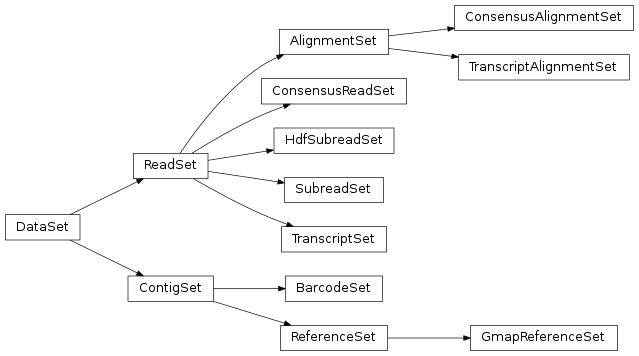
Classes representing DataSets of various types.
-
class
pbcore.io.dataset.DataSetIO.AlignmentSet(*files, **kwargs)¶ Bases:
pbcore.io.dataset.DataSetIO.ReadSetDataSet type specific to Alignments. No type specific Metadata exists, so the base class version is OK (this just ensures type representation on output and expandability
-
__init__(*files, **kwargs)¶ An AlignmentSet
- Args:
files: handled by super referenceFastaFname=None: the reference fasta filename for this alignment. strict=False: see base class skipCounts=False: see base class
-
consolidate(*args, **kwargs)¶ Consolidate a larger number of bam files to a smaller number of bam files (min 1)
- Args:
dataFile: The name of the output file. If numFiles >1 numbers will be added. numFiles: The number of data files to be produced.
-
countRecords(rname=None, winStart=None, winEnd=None)¶ Count the number of records mapped to ‘rname’ that overlap with ‘window’
-
fullRefNames¶ A list of reference full names (full header).
-
induceIndices(force=False)¶ Generate indices for ExternalResources.
Not compatible with DataSet base type
-
intervalContour(rname, tStart=0, tEnd=None)¶ Take a set of index records and build a pileup of intervals, or “contour” describing coverage over the contig
..note:: Naively incrementing values in an array is too slow and takes too much memory. Sorting tuples by starts and ends and iterating through them and the reference (O(nlogn + nlogn + n + n + m)) takes too much memory and time. Iterating over the reference, using numpy conditional indexing at each base on tStart and tEnd columns uses no memory, but is too slow (O(nm), but in numpy (C, hopefully)). Building a delta list via sorted tStarts and tEnds one at a time saves memory and is ~5x faster than the second method above (O(nlogn + nlogn + m)).
-
readsInRange(refName, start, end, buffsize=50, usePbi=True, longest=False, sampleSize=0, justIndices=False)¶ A generator of (usually) BamAlignment objects for the reads in one or more Bam files pointed to by the ExternalResources in this DataSet that have at least one coordinate within the specified range in the reference genome.
Rather than developing some convoluted approach for dealing with auto-inferring the desired references, this method and self.refNames should allow users to compose the desired query.
- Args:
refName: the name of the reference that we are sampling start: the start of the range (inclusive, index relative to reference) end: the end of the range (inclusive, index relative to reference) - Yields:
- BamAlignment objects
- Doctest:
>>> from __future__ import print_function
>>> import pbcore.data.datasets as data
>>> from pbcore.io import AlignmentSet
>>> ds = AlignmentSet(data.getBam())
>>> for read in ds.readsInRange(ds.refNames[15], 100, 150):
...     print('hn: %i' % read.holeNumber)
hn: ...
-
readsInReference(refName)¶ A generator of (usually) BamAlignment objects for the reads in one or more Bam files pointed to by the ExternalResources in this DataSet that are mapped to the specified reference genome.
- Args:
refName: the name of the reference that we are sampling. - Yields:
- BamAlignment objects
- Doctest:
>>> from __future__ import print_function
>>> import pbcore.data.datasets as data
>>> from pbcore.io import AlignmentSet
>>> ds = AlignmentSet(data.getBam())
>>> for read in ds.readsInReference(ds.refNames[15]):
...     print('hn: %i' % read.holeNumber)
hn: ...
-
records¶ A generator of (usually) BamAlignment objects for the records in one or more Bam files pointed to by the ExternalResources in this DataSet.
- Yields:
- A BamAlignment object
- Doctest:
>>> from __future__ import print_function
>>> import pbcore.data.datasets as data
>>> from pbcore.io import AlignmentSet
>>> ds = AlignmentSet(data.getBam())
>>> for record in ds.records:
...     print('hn: %i' % record.holeNumber)
hn: ...
-
recordsByReference¶ The records in this AlignmentSet, sorted by tStart.
-
refIds¶ A dict of refName: refId for the joined referenceInfoTable TODO: depricate in favor of more descriptive rname2tid
-
refInfo(key)¶ Return a column in the referenceInfoTable, tupled with the reference name. TODO(mdsmith)(2016-01-27): pick a better name for this method…
-
refLength(rname)¶ The length of reference ‘rname’. This is expensive, so if you’re going to do many lookups cache self.refLengths locally and use that.
-
refLengths¶ A dict of refName: refLength
-
refNames¶ A list of reference names (id).
-
refWindows¶ Going to be tricky unless the filters are really focused on windowing the reference. Much nesting or duplication and the correct results are really not guaranteed
-
referenceInfo(refName)¶ Select a row from the DataSet.referenceInfoTable using the reference name as a unique key (or ID, if you really have to)
-
referenceInfoTable¶ The merged reference info tables from the external resources. Record.ID is remapped to a unique integer key (though using record.Name is preferred). Record.Names are remapped for cmp.h5 files to be consistent with bam files.
..note:: Reference names are assumed to be unique
-
resourceReaders(refName=False)¶ A generator of Indexed*Reader objects for the ExternalResources in this DataSet.
- Args:
refName: Only yield open resources if they have refName in their referenceInfoTable - Yields:
- An open indexed alignment file
- Doctest:
>>> from __future__ import print_function
>>> import pbcore.data.datasets as data
>>> from pbcore.io import AlignmentSet
>>> ds = AlignmentSet(data.getBam())
>>> for seqFile in ds.resourceReaders():
...     for record in seqFile:
...         print('hn: %i' % record.holeNumber)
hn: ...
-
rname2tid¶ A dict of refName: refId for the joined referenceInfoTable
-
splitContour(contour, splits)¶ Take a contour and a number of splits, return the location of each coverage mediated split with the first at 0
-
split_references(chunks)¶ Chunks requested: 0 or >= num_refs: One chunk per reference 1 to (num_refs - 1): Grouped somewhat evenly by num_records
-
tid2rname¶ A dict of refName: refId for the joined referenceInfoTable
-
-
class
pbcore.io.dataset.DataSetIO.BarcodeSet(*files, **kwargs)¶ Bases:
pbcore.io.dataset.DataSetIO.ContigSetDataSet type specific to Barcodes
-
__init__(*files, **kwargs)¶ DataSet constructor
Initialize representations of the ExternalResources, MetaData, Filters, and LabeledSubsets, parse inputs if possible
- Args:
files: one or more filenames or uris to read strict=False: strictly require all index files skipCounts=False: skip updating counts for faster opening - Doctest:
>>> import os, tempfile
>>> import pbcore.data.datasets as data
>>> from pbcore.io import AlignmentSet, SubreadSet
>>> # Prog like pbalign provides a .bam file:
>>> # e.g. d = AlignmentSet("aligned.bam")
>>> # Something like the test files we have:
>>> inBam = data.getBam()
>>> d = AlignmentSet(inBam)
>>> # A UniqueId is generated, despite being a BAM input
>>> bool(d.uuid)
True
>>> dOldUuid = d.uuid
>>> # They can write this BAM to an XML:
>>> # e.g. d.write("alignmentset.xml")
>>> outdir = tempfile.mkdtemp(suffix="dataset-doctest")
>>> outXml = os.path.join(outdir, 'tempfile.xml')
>>> d.write(outXml)
>>> # And then recover the same XML:
>>> d = AlignmentSet(outXml)
>>> # The UniqueId will be the same
>>> d.uuid == dOldUuid
True
>>> # Inputs can be many and varied
>>> ds1 = AlignmentSet(data.getXml(8), data.getBam(1))
>>> ds1.numExternalResources
2
>>> ds1 = AlignmentSet(data.getFofn())
>>> ds1.numExternalResources
2
>>> # Constructors should be used directly
>>> SubreadSet(data.getSubreadSet(),
...            skipMissing=True)
<SubreadSet...
>>> # Even with untyped inputs
>>> AlignmentSet(data.getBam())
<AlignmentSet...
>>> # AlignmentSets can also be manipulated after opening:
>>> # Add external Resources:
>>> ds = AlignmentSet()
>>> _ = ds.externalResources.addResources(["IdontExist.bam"])
>>> ds.externalResources[-1].resourceId == "IdontExist.bam"
True
>>> # Add an index file
>>> pbiName = "IdontExist.bam.pbi"
>>> ds.externalResources[-1].addIndices([pbiName])
>>> ds.externalResources[-1].indices[0].resourceId == pbiName
True
-
addMetadata(newMetadata, **kwargs)¶ Add metadata specific to this subtype, while leaning on the superclass method for generic metadata. Also enforce metadata type correctness.
-
-
class
pbcore.io.dataset.DataSetIO.ConsensusAlignmentSet(*files, **kwargs)¶ Bases:
pbcore.io.dataset.DataSetIO.AlignmentSetDataset type for aligned CCS reads. Essentially identical to AlignmentSet aside from the contents of the underlying BAM files.
-
class
pbcore.io.dataset.DataSetIO.ConsensusReadSet(*files, **kwargs)¶ Bases:
pbcore.io.dataset.DataSetIO.ReadSetDataSet type specific to CCSreads. No type specific Metadata exists, so the base class version is OK (this just ensures type representation on output and expandability
- Doctest:
>>> import pbcore.data.datasets as data
>>> from pbcore.io import ConsensusReadSet
>>> ds2 = ConsensusReadSet(data.getXml(2), strict=False,
...                        skipMissing=True)
>>> ds2
<ConsensusReadSet...
>>> ds2._metadata
<SubreadSetMetadata...
-
class
pbcore.io.dataset.DataSetIO.ContigSet(*files, **kwargs)¶ Bases:
pbcore.io.dataset.DataSetIO.DataSetDataSet type specific to Contigs
-
__init__(*files, **kwargs)¶ DataSet constructor
Initialize representations of the ExternalResources, MetaData, Filters, and LabeledSubsets, parse inputs if possible
- Args:
files: one or more filenames or uris to read strict=False: strictly require all index files skipCounts=False: skip updating counts for faster opening - Doctest:
>>> import os, tempfile
>>> import pbcore.data.datasets as data
>>> from pbcore.io import AlignmentSet, SubreadSet
>>> # Prog like pbalign provides a .bam file:
>>> # e.g. d = AlignmentSet("aligned.bam")
>>> # Something like the test files we have:
>>> inBam = data.getBam()
>>> d = AlignmentSet(inBam)
>>> # A UniqueId is generated, despite being a BAM input
>>> bool(d.uuid)
True
>>> dOldUuid = d.uuid
>>> # They can write this BAM to an XML:
>>> # e.g. d.write("alignmentset.xml")
>>> outdir = tempfile.mkdtemp(suffix="dataset-doctest")
>>> outXml = os.path.join(outdir, 'tempfile.xml')
>>> d.write(outXml)
>>> # And then recover the same XML:
>>> d = AlignmentSet(outXml)
>>> # The UniqueId will be the same
>>> d.uuid == dOldUuid
True
>>> # Inputs can be many and varied
>>> ds1 = AlignmentSet(data.getXml(8), data.getBam(1))
>>> ds1.numExternalResources
2
>>> ds1 = AlignmentSet(data.getFofn())
>>> ds1.numExternalResources
2
>>> # Constructors should be used directly
>>> SubreadSet(data.getSubreadSet(),
...            skipMissing=True)
<SubreadSet...
>>> # Even with untyped inputs
>>> AlignmentSet(data.getBam())
<AlignmentSet...
>>> # AlignmentSets can also be manipulated after opening:
>>> # Add external Resources:
>>> ds = AlignmentSet()
>>> _ = ds.externalResources.addResources(["IdontExist.bam"])
>>> ds.externalResources[-1].resourceId == "IdontExist.bam"
True
>>> # Add an index file
>>> pbiName = "IdontExist.bam.pbi"
>>> ds.externalResources[-1].addIndices([pbiName])
>>> ds.externalResources[-1].indices[0].resourceId == pbiName
True
-
addMetadata(newMetadata, **kwargs)¶ Add metadata specific to this subtype, while leaning on the superclass method for generic metadata. Also enforce metadata type correctness.
-
consolidate(outfn=None, numFiles=1, useTmp=False)¶ Consolidation should be implemented for window text in names and for filters in ContigSets
-
contigNames¶ The names assigned to the External Resources, or contigs if no name assigned.
-
contigs¶ A generator of contigs from the fastaReader objects for the ExternalResources in this ReferenceSet.
- Yields:
- A fasta file entry
-
get_contig(contig_id)¶ Get a contig by ID
-
induceIndices(force=False)¶ Generate indices for ExternalResources.
Not compatible with DataSet base type
-
resourceReaders(refName=None)¶ A generator of fastaReader objects for the ExternalResources in this ReferenceSet.
- Yields:
- An open fasta file
-
split(nchunks)¶ Deep copy the DataSet into a number of new DataSets containing roughly equal chunks of the ExternalResources or subdatasets.
Examples:
split into exactly n datasets where each addresses a different piece of the collection of contigs:
dset.split(contigs=True, chunks=n)
split into at most n datasets where each addresses a different piece of the collection of contigs, but contigs are kept whole:
dset.split(contigs=True, maxChunks=n)
split into at most n datasets where each addresses a different piece of the collection of contigs and the number of chunks is in part based on the number of reads:
dset.split(contigs=True, maxChunks=n, breakContigs=True)
- Args:
chunks: the number of chunks to split the DataSet. ignoreSubDatasets: (True) do not split by subdatasets contigs: split on contigs instead of external resources zmws: Split by zmws instead of external resources barcodes: Split by barcodes instead of external resources maxChunks: The upper limit on the number of chunks. breakContigs: Whether or not to break contigs byRecords: Split contigs by mapped records, rather than ref length targetSize: The target minimum number of reads per chunk updateCounts: Update the count metadata in each chunk - Returns:
- A list of new DataSet objects (all other information deep copied).
- Doctest:
>>> import pbcore.data.datasets as data
>>> from pbcore.io import AlignmentSet
>>> # splitting is pretty intuitive:
>>> ds1 = AlignmentSet(data.getXml(12))
>>> # but divides up extRes's, so have more than one:
>>> ds1.numExternalResources > 1
True
>>> # the default is one AlignmentSet per ExtRes:
>>> dss = ds1.split()
>>> len(dss) == ds1.numExternalResources
True
>>> # but you can specify a number of AlignmentSets to produce:
>>> dss = ds1.split(chunks=1)
>>> len(dss) == 1
True
>>> dss = ds1.split(chunks=2, ignoreSubDatasets=True)
>>> len(dss) == 2
True
>>> # The resulting objects are similar:
>>> dss[0].uuid == dss[1].uuid
False
>>> dss[0].name == dss[1].name
True
>>> # Previously merged datasets are 'unmerged' upon split, unless
>>> # otherwise specified.
>>> # Lets try merging and splitting on subdatasets:
>>> ds1 = AlignmentSet(data.getXml(8))
>>> ds1.totalLength
123588
>>> ds1tl = ds1.totalLength
>>> ds2 = AlignmentSet(data.getXml(11))
>>> ds2.totalLength
117086
>>> ds2tl = ds2.totalLength
>>> # merge:
>>> dss = ds1 + ds2
>>> dss.totalLength == (ds1tl + ds2tl)
True
>>> # unmerge:
>>> ds1, ds2 = sorted(
... dss.split(2, ignoreSubDatasets=False),
... key=lambda x: x.totalLength, reverse=True)
>>> ds1.totalLength == ds1tl
True
>>> ds2.totalLength == ds2tl
True
-
updateCounts()¶ Update the TotalLength and NumRecords for this DataSet.
Not compatible with the base DataSet class, which has no ability to touch ExternalResources. -1 is used as a sentinel value for failed size determination. It should never be written out to XML in regular use.
-
-
class
pbcore.io.dataset.DataSetIO.DataSet(*files, **kwargs)¶ Bases:
objectThe record containing the DataSet information, with possible type specific subclasses
-
__add__(otherDataset)¶ Merge the representations of two DataSets without modifying the original datasets. (Fails if filters are incompatible).
- Args:
otherDataset: a DataSet to merge with self - Returns:
- A new DataSet with members containing the union of the input DataSets’ members and subdatasets representing the input DataSets
- Doctest:
>>> import pbcore.data.datasets as data
>>> from pbcore.io import AlignmentSet
>>> from pbcore.io.dataset.DataSetWriter import toXml
>>> # xmls with different resourceIds: success
>>> ds1 = AlignmentSet(data.getXml(no=8))
>>> ds2 = AlignmentSet(data.getXml(no=11))
>>> ds3 = ds1 + ds2
>>> expected = ds1.numExternalResources + ds2.numExternalResources
>>> ds3.numExternalResources == expected
True
>>> # xmls with different resourceIds but conflicting filters:
>>> # failure to merge
>>> ds2.filters.addRequirement(rname=[('=', 'E.faecalis.1')])
>>> ds3 = ds1 + ds2
>>> ds3
>>> # xmls with same resourceIds: ignores new inputs
>>> ds1 = AlignmentSet(data.getXml(no=8))
>>> ds2 = AlignmentSet(data.getXml(no=8))
>>> ds3 = ds1 + ds2
>>> expected = ds1.numExternalResources
>>> ds3.numExternalResources == expected
True
-
__deepcopy__(memo)¶ Deep copy this Dataset by recursively deep copying the members (objMetadata, DataSet metadata, externalResources, filters and subdatasets)
-
__eq__(other)¶ Test for DataSet equality. The method specified in the documentation calls for md5 hashing the “Core XML” elements and comparing. This is the same procedure for generating the Uuid, so the same method may be used. However, as simultaneously or regularly updating the Uuid is not specified, we opt to not set the newUuid when checking for equality.
- Args:
other: The other DataSet to compare to this DataSet. - Returns:
- T/F the Core XML elements of this and the other DataSet hash to the same value
-
__init__(*files, **kwargs)¶ DataSet constructor
Initialize representations of the ExternalResources, MetaData, Filters, and LabeledSubsets, parse inputs if possible
- Args:
files: one or more filenames or uris to read strict=False: strictly require all index files skipCounts=False: skip updating counts for faster opening - Doctest:
>>> import os, tempfile
>>> import pbcore.data.datasets as data
>>> from pbcore.io import AlignmentSet, SubreadSet
>>> # Prog like pbalign provides a .bam file:
>>> # e.g. d = AlignmentSet("aligned.bam")
>>> # Something like the test files we have:
>>> inBam = data.getBam()
>>> d = AlignmentSet(inBam)
>>> # A UniqueId is generated, despite being a BAM input
>>> bool(d.uuid)
True
>>> dOldUuid = d.uuid
>>> # They can write this BAM to an XML:
>>> # e.g. d.write("alignmentset.xml")
>>> outdir = tempfile.mkdtemp(suffix="dataset-doctest")
>>> outXml = os.path.join(outdir, 'tempfile.xml')
>>> d.write(outXml)
>>> # And then recover the same XML:
>>> d = AlignmentSet(outXml)
>>> # The UniqueId will be the same
>>> d.uuid == dOldUuid
True
>>> # Inputs can be many and varied
>>> ds1 = AlignmentSet(data.getXml(8), data.getBam(1))
>>> ds1.numExternalResources
2
>>> ds1 = AlignmentSet(data.getFofn())
>>> ds1.numExternalResources
2
>>> # Constructors should be used directly
>>> SubreadSet(data.getSubreadSet(),
...            skipMissing=True)
<SubreadSet...
>>> # Even with untyped inputs
>>> AlignmentSet(data.getBam())
<AlignmentSet...
>>> # AlignmentSets can also be manipulated after opening:
>>> # Add external Resources:
>>> ds = AlignmentSet()
>>> _ = ds.externalResources.addResources(["IdontExist.bam"])
>>> ds.externalResources[-1].resourceId == "IdontExist.bam"
True
>>> # Add an index file
>>> pbiName = "IdontExist.bam.pbi"
>>> ds.externalResources[-1].addIndices([pbiName])
>>> ds.externalResources[-1].indices[0].resourceId == pbiName
True
-
__repr__()¶ Represent the dataset with an informative string:
- Returns:
- “<type uuid filenames>”
-
addDatasets(otherDataSet)¶ Add subsets to a DataSet object using other DataSets.
The following method of enabling merge-based split prevents nesting of datasets more than one deep. Nested relationships are flattened.
Note
Most often used by the __add__ method, rather than directly.
-
addExternalResources(newExtResources, updateCount=True)¶ Add additional ExternalResource objects, ensuring no duplicate resourceIds. Most often used by the __add__ method, rather than directly.
- Args:
newExtResources: A list of new ExternalResource objects, either created de novo from a raw bam input, parsed from an xml input, or already contained in a separate DataSet object and being merged. - Doctest:
>>> from pbcore.io.dataset.DataSetMembers import ExternalResource
>>> from pbcore.io import DataSet
>>> ds = DataSet()
>>> # it is possible to add ExtRes's as ExternalResource objects:
>>> er1 = ExternalResource()
>>> er1.resourceId = "test1.bam"
>>> er2 = ExternalResource()
>>> er2.resourceId = "test2.bam"
>>> er3 = ExternalResource()
>>> er3.resourceId = "test1.bam"
>>> ds.addExternalResources([er1], updateCount=False)
>>> len(ds.externalResources)
1
>>> # different resourceId: succeeds
>>> ds.addExternalResources([er2], updateCount=False)
>>> len(ds.externalResources)
2
>>> # same resourceId: fails
>>> ds.addExternalResources([er3], updateCount=False)
>>> len(ds.externalResources)
2
>>> # but it is probably better to add them a little deeper:
>>> ds.externalResources.addResources(
...     ["test3.bam"])[0].addIndices(["test3.bam.bai"])
-
addFilters(newFilters, underConstruction=False)¶ Add new or extend the current list of filters. Public because there is already a reasonably compelling reason (the console script entry point). Most often used by the __add__ method.
- Args:
newFilters: a Filters object or properly formatted Filters record - Doctest:
>>> from __future__ import print_function
>>> import pbcore.data.datasets as data
>>> from pbcore.io import SubreadSet
>>> from pbcore.io.dataset.DataSetMembers import Filters
>>> ds1 = SubreadSet()
>>> filt = Filters()
>>> filt.addRequirement(rq=[('>', '0.85')])
>>> ds1.addFilters(filt)
>>> print(ds1.filters)
( rq > 0.85 )
>>> # Or load with a DataSet
>>> ds2 = DataSet(data.getXml(16))
>>> print(ds2.filters)
...
( rname = E.faecalis...
-
addMetadata(newMetadata, **kwargs)¶ Add dataset metadata.
Currently we ignore duplicates while merging (though perhaps other transformations are more appropriate) and plan to remove/merge conflicting metadata with identical attribute names.
All metadata elements should be strings, deepcopy shouldn’t be necessary.
This method is most often used by the __add__ method, rather than directly.
- Args:
newMetadata: a dictionary of object metadata from an XML file (or carefully crafted to resemble one), or a wrapper around said dictionary kwargs: new metadata fields to be piled into the current metadata (as an attribute) - Doctest:
>>> from __future__ import print_function
>>> import pbcore.data.datasets as data
>>> from pbcore.io import DataSet
>>> ds = DataSet()
>>> # it is possible to add new metadata:
>>> ds.addMetadata(None, Name='LongReadsRock')
>>> print(ds._metadata.getV(container='attrib', tag='Name'))
LongReadsRock
>>> # but most will be loaded and modified:
>>> ds2 = DataSet(data.getXml(no=8))
>>> ds2._metadata.totalLength
123588
>>> ds2._metadata.totalLength = 100000
>>> ds2._metadata.totalLength
100000
>>> ds2._metadata.totalLength += 100000
>>> ds2._metadata.totalLength
200000
>>> ds3 = DataSet(data.getXml(no=8))
>>> ds3.loadStats(data.getStats())
>>> ds4 = DataSet(data.getXml(no=11))
>>> ds4.loadStats(data.getStats())
>>> ds5 = ds3 + ds4
-
barcodes¶ Return the list of barcodes explicitly set by filters via DataSet.split(barcodes=True).
-
classmethod
castableTypes()¶ The types to which this DataSet type may be cast. This is a property instead of a member variable as we can enforce casting limits here (and modify if needed by overriding them in subclasses).
- Returns:
- A dictionary of MetaType->Class mappings, e.g. ‘DataSet’: DataSet
-
close()¶ Close all of the opened resource readers
-
copy(asType=None)¶ Deep copy the representation of this DataSet
- Args:
asType: The type of DataSet to return, e.g. ‘AlignmentSet’ - Returns:
- A DataSet object that is identical but for UniqueId
- Doctest:
>>> import pbcore.data.datasets as data
>>> from pbcore.io import DataSet, SubreadSet
>>> ds1 = DataSet(data.getXml(12))
>>> # Deep copying datasets is easy:
>>> ds2 = ds1.copy()
>>> # But the resulting uuid's should be different.
>>> ds1 == ds2
False
>>> ds1.uuid == ds2.uuid
False
>>> ds1 is ds2
False
>>> # Most members are identical
>>> ds1.name == ds2.name
True
>>> ds1.externalResources == ds2.externalResources
True
>>> ds1.filters == ds2.filters
True
>>> ds1.subdatasets == ds2.subdatasets
True
>>> len(ds1.subdatasets) == 2
True
>>> len(ds2.subdatasets) == 2
True
>>> # Except for the one that stores the uuid:
>>> ds1.objMetadata == ds2.objMetadata
False
>>> # And of course identical != the same object:
>>> assert not reduce(lambda x, y: x or y,
...                   [ds1d is ds2d for ds1d in
...                    ds1.subdatasets for ds2d in
...                    ds2.subdatasets])
>>> # But types are maintained:
>>> ds1 = SubreadSet(data.getXml(no=10), strict=True)
>>> ds1.metadata
<SubreadSetMetadata...
>>> ds2 = ds1.copy()
>>> ds2.metadata
<SubreadSetMetadata...
>>> # Lets try casting
>>> ds1 = DataSet(data.getBam())
>>> ds1
<DataSet...
>>> ds1 = ds1.copy(asType='SubreadSet')
>>> ds1
<SubreadSet...
>>> # Lets do some illicit casting
>>> ds1 = ds1.copy(asType='ReferenceSet')
Traceback (most recent call last):
TypeError: Cannot cast from SubreadSet to ReferenceSet
>>> # Lets try not having to cast
>>> ds1 = SubreadSet(data.getBam())
>>> ds1
<SubreadSet...
-
copyFiles(outdir)¶ Copy all of the top level ExternalResources to an output directory ‘outdir’
-
copyTo(dest, relative=False, subdatasets=False)¶ Doesn’t resolve resource name collisions
-
createdAt¶ Return the DataSet CreatedAt timestamp
-
description¶ The description of this DataSet
-
disableFilters()¶ Disable read filtering for this object
-
enableFilters()¶ Re-enable read filtering for this object
-
filters¶ Limit setting to ensure cache hygiene and filter compatibility
-
induceIndices(force=False)¶ Generate indices for ExternalResources.
Not compatible with DataSet base type
-
loadMetadata(filename)¶ Load pipeline metadata from a <moviename>.metadata.xml file (or other DataSet)
- Args:
filename: the filename of a <moviename>.metadata.xml file
-
loadStats(filename=None)¶ Load pipeline statistics from a <moviename>.sts.xml file. The subset of these data that are defined in the DataSet XSD become available through via DataSet.metadata.summaryStats.<…> and will be written out to the DataSet XML format according to the DataSet XML XSD.
- Args:
filename: the filename of a <moviename>.sts.xml file. If None: load all stats from sts.xml files, including for subdatasets. - Doctest:
>>> import pbcore.data.datasets as data
>>> from pbcore.io import AlignmentSet
>>> ds1 = AlignmentSet(data.getXml(8))
>>> ds1.loadStats(data.getStats())
>>> ds2 = AlignmentSet(data.getXml(11))
>>> ds2.loadStats(data.getStats())
>>> ds3 = ds1 + ds2
>>> ds1.metadata.summaryStats.prodDist.bins
[1576, 901, 399, 0]
>>> ds2.metadata.summaryStats.prodDist.bins
[1576, 901, 399, 0]
>>> ds3.metadata.summaryStats.prodDist.bins
[3152, 1802, 798, 0]
-
makePathsAbsolute(curStart='.')¶ As part of the validation process, make all ResourceIds absolute URIs rather than relative paths. Generally not called by API users.
- Args:
curStart: The location from which relative paths should emanate.
-
makePathsRelative(outDir=False)¶ Make things easier for writing test cases: make all ResourceIds relative paths rather than absolute paths. A less common use case for API consumers.
- Args:
outDir: The location from which relative paths should originate
-
merge(other, copyOnMerge=True, newuuid=True)¶ Merge an ‘other’ dataset with this dataset, same as add operator, but can take argumens
-
metadata¶ Return the DataSet metadata as a DataSetMetadata object. Attributes should be populated intuitively, but see DataSetMetadata documentation for more detail.
-
name¶ The name of this DataSet
-
newRandomUuid()¶ Generate a new random UUID
-
newUuid(setter=True, random=False)¶ Generate and enforce the uniqueness of an ID for a new DataSet. While user setable fields are stripped out of the Core DataSet object used for comparison, the previous UniqueId is not. That means that copies will still be unique, despite having the same contents.
- Args:
setter=True: Setting to False allows MD5 hashes to be generated (e.g. for comparison with other objects) without modifying the object’s UniqueId random=False: If true, the new UUID will be generated randomly. Otherwise a hashing algo will be used from “core” elements of the XML. This will yield a reproducible UUID for datasets that have the same “core” attributes/metadata. - Returns:
- The new Id, a properly formatted md5 hash of the Core DataSet
- Doctest:
>>> from pbcore.io import AlignmentSet
>>> ds = AlignmentSet()
>>> old = ds.uuid
>>> _ = ds.newUuid()
>>> old != ds.uuid
True
-
numExternalResources¶ The number of ExternalResources in this DataSet
-
numRecords¶ The number of records in this DataSet (from the metadata)
-
processFilters()¶ Generate a list of functions to apply to a read, all of which return T/F. Each function is an OR filter, so any() true passes the read. These functions are the AND filters, and will likely check all() of other functions. These filtration functions are cached so that they are not regenerated from the base filters for every read
-
reFilter(light=True)¶ The filters on this dataset have changed, update DataSet state as needed
-
readsInSubDatasets(subNames=None)¶ To be used in conjunction with self.subSetNames
-
records¶ A generator of (usually) BamAlignment objects for the records in one or more Bam files pointed to by the ExternalResources in this DataSet.
- Yields:
- A BamAlignment object
- Doctest:
>>> from __future__ import print_function
>>> import pbcore.data.datasets as data
>>> from pbcore.io import AlignmentSet
>>> ds = AlignmentSet(data.getBam())
>>> for record in ds.records:
...     print('hn: %i' % record.holeNumber)
hn: ...
-
resourceReaders()¶ Return a list of open pbcore Reader objects for the top level ExternalResources in this DataSet
-
split(chunks=0, ignoreSubDatasets=True, contigs=False, maxChunks=0, breakContigs=False, targetSize=5000, zmws=False, barcodes=False, byRecords=False, updateCounts=True)¶ Deep copy the DataSet into a number of new DataSets containing roughly equal chunks of the ExternalResources or subdatasets.
Examples:
split into exactly n datasets where each addresses a different piece of the collection of contigs:
dset.split(contigs=True, chunks=n)
split into at most n datasets where each addresses a different piece of the collection of contigs, but contigs are kept whole:
dset.split(contigs=True, maxChunks=n)
split into at most n datasets where each addresses a different piece of the collection of contigs and the number of chunks is in part based on the number of reads:
dset.split(contigs=True, maxChunks=n, breakContigs=True)
- Args:
chunks: the number of chunks to split the DataSet. ignoreSubDatasets: (True) do not split by subdatasets contigs: split on contigs instead of external resources zmws: Split by zmws instead of external resources barcodes: Split by barcodes instead of external resources maxChunks: The upper limit on the number of chunks. breakContigs: Whether or not to break contigs byRecords: Split contigs by mapped records, rather than ref length targetSize: The target minimum number of reads per chunk updateCounts: Update the count metadata in each chunk - Returns:
- A list of new DataSet objects (all other information deep copied).
- Doctest:
>>> import pbcore.data.datasets as data
>>> from pbcore.io import AlignmentSet
>>> # splitting is pretty intuitive:
>>> ds1 = AlignmentSet(data.getXml(12))
>>> # but divides up extRes's, so have more than one:
>>> ds1.numExternalResources > 1
True
>>> # the default is one AlignmentSet per ExtRes:
>>> dss = ds1.split()
>>> len(dss) == ds1.numExternalResources
True
>>> # but you can specify a number of AlignmentSets to produce:
>>> dss = ds1.split(chunks=1)
>>> len(dss) == 1
True
>>> dss = ds1.split(chunks=2, ignoreSubDatasets=True)
>>> len(dss) == 2
True
>>> # The resulting objects are similar:
>>> dss[0].uuid == dss[1].uuid
False
>>> dss[0].name == dss[1].name
True
>>> # Previously merged datasets are 'unmerged' upon split, unless
>>> # otherwise specified.
>>> # Lets try merging and splitting on subdatasets:
>>> ds1 = AlignmentSet(data.getXml(8))
>>> ds1.totalLength
123588
>>> ds1tl = ds1.totalLength
>>> ds2 = AlignmentSet(data.getXml(11))
>>> ds2.totalLength
117086
>>> ds2tl = ds2.totalLength
>>> # merge:
>>> dss = ds1 + ds2
>>> dss.totalLength == (ds1tl + ds2tl)
True
>>> # unmerge:
>>> ds1, ds2 = sorted(
... dss.split(2, ignoreSubDatasets=False),
... key=lambda x: x.totalLength, reverse=True)
>>> ds1.totalLength == ds1tl
True
>>> ds2.totalLength == ds2tl
True
-
subSetNames¶ The subdataset names present in this DataSet
The tags of this DataSet
-
timeStampedName¶ The timeStampedName of this DataSet
-
toExternalFiles()¶ Returns a list of top level external resources (no indices).
-
toFofn(outfn=None, uri=False, relative=False)¶ Return a list of resource filenames (and write to optional outfile)
- Args:
outfn: (None) the file to which the resouce filenames are to be written. If None, the only emission is a returned list of file names. uri: (t/F) write the resource filenames as URIs. relative: (t/F) emit paths relative to outfofn or ‘.’ if no outfofn - Returns:
- A list of filenames or uris
- Writes:
- (Optional) A file containing a list of filenames or uris
- Doctest:
>>> from pbcore.io import DataSet
>>> DataSet("bam1.bam", "bam2.bam", strict=False,
...         skipMissing=True).toFofn(uri=False)
['bam1.bam', 'bam2.bam']
-
totalLength¶ The total length of this DataSet
-
uniqueId¶ The UniqueId of this DataSet
-
updateCounts()¶ Update the TotalLength and NumRecords for this DataSet.
Not compatible with the base DataSet class, which has no ability to touch ExternalResources. -1 is used as a sentinel value for failed size determination. It should never be written out to XML in regular use.
-
uuid¶ The UniqueId of this DataSet
-
write(outFile, validate=True, modPaths=None, relPaths=None, pretty=True)¶ Write to disk as an XML file
- Args:
outFile: The filename of the xml file to be created validate: T/F (True) validate the ExternalResource ResourceIds relPaths: T/F (None/no change) make the ExternalResource ResourceIds relative instead of absolute filenames modPaths: DEPRECATED (T/F) allow paths to be modified - Doctest:
>>> import pbcore.data.datasets as data
>>> from pbcore.io import DataSet
>>> import tempfile, os
>>> outdir = tempfile.mkdtemp(suffix="dataset-doctest")
>>> outfile = os.path.join(outdir, 'tempfile.xml')
>>> ds1 = DataSet(data.getXml(), skipMissing=True)
>>> ds1.write(outfile, validate=False)
>>> ds2 = DataSet(outfile, skipMissing=True)
>>> ds1 == ds2
True
-
zmwRanges¶ Return the end-inclusive range of ZMWs covered by the dataset if this was explicitly set by filters via DataSet.split(zmws=True).
-
-
class
pbcore.io.dataset.DataSetIO.GmapReferenceSet(*files, **kwargs)¶ Bases:
pbcore.io.dataset.DataSetIO.ReferenceSetDataSet type specific to GMAP References
-
__init__(*files, **kwargs)¶ DataSet constructor
Initialize representations of the ExternalResources, MetaData, Filters, and LabeledSubsets, parse inputs if possible
- Args:
files: one or more filenames or uris to read strict=False: strictly require all index files skipCounts=False: skip updating counts for faster opening - Doctest:
>>> import os, tempfile
>>> import pbcore.data.datasets as data
>>> from pbcore.io import AlignmentSet, SubreadSet
>>> # Prog like pbalign provides a .bam file:
>>> # e.g. d = AlignmentSet("aligned.bam")
>>> # Something like the test files we have:
>>> inBam = data.getBam()
>>> d = AlignmentSet(inBam)
>>> # A UniqueId is generated, despite being a BAM input
>>> bool(d.uuid)
True
>>> dOldUuid = d.uuid
>>> # They can write this BAM to an XML:
>>> # e.g. d.write("alignmentset.xml")
>>> outdir = tempfile.mkdtemp(suffix="dataset-doctest")
>>> outXml = os.path.join(outdir, 'tempfile.xml')
>>> d.write(outXml)
>>> # And then recover the same XML:
>>> d = AlignmentSet(outXml)
>>> # The UniqueId will be the same
>>> d.uuid == dOldUuid
True
>>> # Inputs can be many and varied
>>> ds1 = AlignmentSet(data.getXml(8), data.getBam(1))
>>> ds1.numExternalResources
2
>>> ds1 = AlignmentSet(data.getFofn())
>>> ds1.numExternalResources
2
>>> # Constructors should be used directly
>>> SubreadSet(data.getSubreadSet(),
...            skipMissing=True)
<SubreadSet...
>>> # Even with untyped inputs
>>> AlignmentSet(data.getBam())
<AlignmentSet...
>>> # AlignmentSets can also be manipulated after opening:
>>> # Add external Resources:
>>> ds = AlignmentSet()
>>> _ = ds.externalResources.addResources(["IdontExist.bam"])
>>> ds.externalResources[-1].resourceId == "IdontExist.bam"
True
>>> # Add an index file
>>> pbiName = "IdontExist.bam.pbi"
>>> ds.externalResources[-1].addIndices([pbiName])
>>> ds.externalResources[-1].indices[0].resourceId == pbiName
True
-
-
class
pbcore.io.dataset.DataSetIO.HdfSubreadSet(*files, **kwargs)¶ Bases:
pbcore.io.dataset.DataSetIO.ReadSet-
__init__(*files, **kwargs)¶ DataSet constructor
Initialize representations of the ExternalResources, MetaData, Filters, and LabeledSubsets, parse inputs if possible
- Args:
files: one or more filenames or uris to read strict=False: strictly require all index files skipCounts=False: skip updating counts for faster opening - Doctest:
>>> import os, tempfile
>>> import pbcore.data.datasets as data
>>> from pbcore.io import AlignmentSet, SubreadSet
>>> # Prog like pbalign provides a .bam file:
>>> # e.g. d = AlignmentSet("aligned.bam")
>>> # Something like the test files we have:
>>> inBam = data.getBam()
>>> d = AlignmentSet(inBam)
>>> # A UniqueId is generated, despite being a BAM input
>>> bool(d.uuid)
True
>>> dOldUuid = d.uuid
>>> # They can write this BAM to an XML:
>>> # e.g. d.write("alignmentset.xml")
>>> outdir = tempfile.mkdtemp(suffix="dataset-doctest")
>>> outXml = os.path.join(outdir, 'tempfile.xml')
>>> d.write(outXml)
>>> # And then recover the same XML:
>>> d = AlignmentSet(outXml)
>>> # The UniqueId will be the same
>>> d.uuid == dOldUuid
True
>>> # Inputs can be many and varied
>>> ds1 = AlignmentSet(data.getXml(8), data.getBam(1))
>>> ds1.numExternalResources
2
>>> ds1 = AlignmentSet(data.getFofn())
>>> ds1.numExternalResources
2
>>> # Constructors should be used directly
>>> SubreadSet(data.getSubreadSet(),
...            skipMissing=True)
<SubreadSet...
>>> # Even with untyped inputs
>>> AlignmentSet(data.getBam())
<AlignmentSet...
>>> # AlignmentSets can also be manipulated after opening:
>>> # Add external Resources:
>>> ds = AlignmentSet()
>>> _ = ds.externalResources.addResources(["IdontExist.bam"])
>>> ds.externalResources[-1].resourceId == "IdontExist.bam"
True
>>> # Add an index file
>>> pbiName = "IdontExist.bam.pbi"
>>> ds.externalResources[-1].addIndices([pbiName])
>>> ds.externalResources[-1].indices[0].resourceId == pbiName
True
-
consolidate(dataFile, numFiles=1)¶ Consolidate a larger number of bam files to a smaller number of bam files (min 1)
- Args:
dataFile: The name of the output file. If numFiles >1 numbers will be added. numFiles: The number of data files to be produced.
-
induceIndices(force=False)¶ Generate indices for ExternalResources.
Not compatible with DataSet base type
-
updateCounts()¶ Overriding here so we don’t have to assertIndexed
-
-
class
pbcore.io.dataset.DataSetIO.ReadSet(*files, **kwargs)¶ Bases:
pbcore.io.dataset.DataSetIO.DataSetBase type for read sets, should probably never be used as a concrete class
-
__init__(*files, **kwargs)¶ DataSet constructor
Initialize representations of the ExternalResources, MetaData, Filters, and LabeledSubsets, parse inputs if possible
- Args:
files: one or more filenames or uris to read strict=False: strictly require all index files skipCounts=False: skip updating counts for faster opening - Doctest:
>>> import os, tempfile
>>> import pbcore.data.datasets as data
>>> from pbcore.io import AlignmentSet, SubreadSet
>>> # Prog like pbalign provides a .bam file:
>>> # e.g. d = AlignmentSet("aligned.bam")
>>> # Something like the test files we have:
>>> inBam = data.getBam()
>>> d = AlignmentSet(inBam)
>>> # A UniqueId is generated, despite being a BAM input
>>> bool(d.uuid)
True
>>> dOldUuid = d.uuid
>>> # They can write this BAM to an XML:
>>> # e.g. d.write("alignmentset.xml")
>>> outdir = tempfile.mkdtemp(suffix="dataset-doctest")
>>> outXml = os.path.join(outdir, 'tempfile.xml')
>>> d.write(outXml)
>>> # And then recover the same XML:
>>> d = AlignmentSet(outXml)
>>> # The UniqueId will be the same
>>> d.uuid == dOldUuid
True
>>> # Inputs can be many and varied
>>> ds1 = AlignmentSet(data.getXml(8), data.getBam(1))
>>> ds1.numExternalResources
2
>>> ds1 = AlignmentSet(data.getFofn())
>>> ds1.numExternalResources
2
>>> # Constructors should be used directly
>>> SubreadSet(data.getSubreadSet(),
...            skipMissing=True)
<SubreadSet...
>>> # Even with untyped inputs
>>> AlignmentSet(data.getBam())
<AlignmentSet...
>>> # AlignmentSets can also be manipulated after opening:
>>> # Add external Resources:
>>> ds = AlignmentSet()
>>> _ = ds.externalResources.addResources(["IdontExist.bam"])
>>> ds.externalResources[-1].resourceId == "IdontExist.bam"
True
>>> # Add an index file
>>> pbiName = "IdontExist.bam.pbi"
>>> ds.externalResources[-1].addIndices([pbiName])
>>> ds.externalResources[-1].indices[0].resourceId == pbiName
True
-
addMetadata(newMetadata, **kwargs)¶ Add metadata specific to this subtype, while leaning on the superclass method for generic metadata. Also enforce metadata type correctness.
-
assertBarcoded()¶ Test whether all resources are barcoded files
-
consolidate(dataFile, numFiles=1, useTmp=True)¶ Consolidate a larger number of bam files to a smaller number of bam files (min 1)
- Args:
dataFile: The name of the output file. If numFiles >1 numbers will be added. numFiles: The number of data files to be produced.
-
hasPbi¶ Test whether all resources are opened as IndexedBamReader objects
-
induceIndices(force=False)¶ Generate indices for ExternalResources.
Not compatible with DataSet base type
-
isBarcoded¶ Determine whether all resources are barcoded files
-
isCmpH5¶ Test whether all resources are cmp.h5 files
-
mov2qid¶ A dict of movieId: movieName for the joined readGroupTable
-
movieIds¶ A dict of movieName: movieId for the joined readGroupTable TODO: depricate this for more descriptive mov2qid
-
qid2mov¶ A dict of movieId: movieName for the joined readGroupTable
-
readGroupTable¶ Combine the readGroupTables of each external resource
-
resourceReaders()¶ Open the files in this ReadSet
-
split_movies(chunks)¶ Chunks requested: 0 or >= num_movies: One chunk per movie 1 to (num_movies - 1): Grouped somewhat evenly by num_records
-
updateCounts()¶ Update the TotalLength and NumRecords for this DataSet.
Not compatible with the base DataSet class, which has no ability to touch ExternalResources. -1 is used as a sentinel value for failed size determination. It should never be written out to XML in regular use.
-
-
class
pbcore.io.dataset.DataSetIO.ReferenceSet(*files, **kwargs)¶ Bases:
pbcore.io.dataset.DataSetIO.ContigSetDataSet type specific to References
-
__init__(*files, **kwargs)¶ DataSet constructor
Initialize representations of the ExternalResources, MetaData, Filters, and LabeledSubsets, parse inputs if possible
- Args:
files: one or more filenames or uris to read strict=False: strictly require all index files skipCounts=False: skip updating counts for faster opening - Doctest:
>>> import os, tempfile
>>> import pbcore.data.datasets as data
>>> from pbcore.io import AlignmentSet, SubreadSet
>>> # Prog like pbalign provides a .bam file:
>>> # e.g. d = AlignmentSet("aligned.bam")
>>> # Something like the test files we have:
>>> inBam = data.getBam()
>>> d = AlignmentSet(inBam)
>>> # A UniqueId is generated, despite being a BAM input
>>> bool(d.uuid)
True
>>> dOldUuid = d.uuid
>>> # They can write this BAM to an XML:
>>> # e.g. d.write("alignmentset.xml")
>>> outdir = tempfile.mkdtemp(suffix="dataset-doctest")
>>> outXml = os.path.join(outdir, 'tempfile.xml')
>>> d.write(outXml)
>>> # And then recover the same XML:
>>> d = AlignmentSet(outXml)
>>> # The UniqueId will be the same
>>> d.uuid == dOldUuid
True
>>> # Inputs can be many and varied
>>> ds1 = AlignmentSet(data.getXml(8), data.getBam(1))
>>> ds1.numExternalResources
2
>>> ds1 = AlignmentSet(data.getFofn())
>>> ds1.numExternalResources
2
>>> # Constructors should be used directly
>>> SubreadSet(data.getSubreadSet(),
...            skipMissing=True)
<SubreadSet...
>>> # Even with untyped inputs
>>> AlignmentSet(data.getBam())
<AlignmentSet...
>>> # AlignmentSets can also be manipulated after opening:
>>> # Add external Resources:
>>> ds = AlignmentSet()
>>> _ = ds.externalResources.addResources(["IdontExist.bam"])
>>> ds.externalResources[-1].resourceId == "IdontExist.bam"
True
>>> # Add an index file
>>> pbiName = "IdontExist.bam.pbi"
>>> ds.externalResources[-1].addIndices([pbiName])
>>> ds.externalResources[-1].indices[0].resourceId == pbiName
True
-
refNames¶ The reference names assigned to the External Resources, or contigs if no name assigned.
-
-
class
pbcore.io.dataset.DataSetIO.SubreadSet(*files, **kwargs)¶ Bases:
pbcore.io.dataset.DataSetIO.ReadSetDataSet type specific to Subreads
DocTest:
>>> from pbcore.io import SubreadSet
>>> from pbcore.io.dataset.DataSetMembers import ExternalResources
>>> import pbcore.data.datasets as data
>>> ds1 = SubreadSet(data.getXml(no=5), skipMissing=True)
>>> ds2 = SubreadSet(data.getXml(no=5), skipMissing=True)
>>> # So they don't conflict:
>>> ds2.externalResources = ExternalResources()
>>> ds1
<SubreadSet...
>>> ds1._metadata
<SubreadSetMetadata...
>>> ds1._metadata
<SubreadSetMetadata...
>>> ds1.metadata
<SubreadSetMetadata...
>>> len(ds1.metadata.collections)
1
>>> len(ds2.metadata.collections)
1
>>> ds3 = ds1 + ds2
>>> len(ds3.metadata.collections)
2
>>> ds4 = SubreadSet(data.getSubreadSet(), skipMissing=True)
>>> ds4
<SubreadSet...
>>> ds4._metadata
<SubreadSetMetadata...
>>> len(ds4.metadata.collections)
1
-
__init__(*files, **kwargs)¶ DataSet constructor
Initialize representations of the ExternalResources, MetaData, Filters, and LabeledSubsets, parse inputs if possible
- Args:
files: one or more filenames or uris to read strict=False: strictly require all index files skipCounts=False: skip updating counts for faster opening - Doctest:
>>> import os, tempfile
>>> import pbcore.data.datasets as data
>>> from pbcore.io import AlignmentSet, SubreadSet
>>> # Prog like pbalign provides a .bam file:
>>> # e.g. d = AlignmentSet("aligned.bam")
>>> # Something like the test files we have:
>>> inBam = data.getBam()
>>> d = AlignmentSet(inBam)
>>> # A UniqueId is generated, despite being a BAM input
>>> bool(d.uuid)
True
>>> dOldUuid = d.uuid
>>> # They can write this BAM to an XML:
>>> # e.g. d.write("alignmentset.xml")
>>> outdir = tempfile.mkdtemp(suffix="dataset-doctest")
>>> outXml = os.path.join(outdir, 'tempfile.xml')
>>> d.write(outXml)
>>> # And then recover the same XML:
>>> d = AlignmentSet(outXml)
>>> # The UniqueId will be the same
>>> d.uuid == dOldUuid
True
>>> # Inputs can be many and varied
>>> ds1 = AlignmentSet(data.getXml(8), data.getBam(1))
>>> ds1.numExternalResources
2
>>> ds1 = AlignmentSet(data.getFofn())
>>> ds1.numExternalResources
2
>>> # Constructors should be used directly
>>> SubreadSet(data.getSubreadSet(),
...            skipMissing=True)
<SubreadSet...
>>> # Even with untyped inputs
>>> AlignmentSet(data.getBam())
<AlignmentSet...
>>> # AlignmentSets can also be manipulated after opening:
>>> # Add external Resources:
>>> ds = AlignmentSet()
>>> _ = ds.externalResources.addResources(["IdontExist.bam"])
>>> ds.externalResources[-1].resourceId == "IdontExist.bam"
True
>>> # Add an index file
>>> pbiName = "IdontExist.bam.pbi"
>>> ds.externalResources[-1].addIndices([pbiName])
>>> ds.externalResources[-1].indices[0].resourceId == pbiName
True
-
getMovieSampleNames()¶ Map the BioSample names in Collection metadata to “context” ID, i.e. movie names. Used for deconvoluting multi-sample inputs. This function will raise a KeyError if a movie name is not unique, or a ValueError if there is not a 1-to-1 mapping of sample to to movie.
-
-
class
pbcore.io.dataset.DataSetIO.TranscriptAlignmentSet(*files, **kwargs)¶ Bases:
pbcore.io.dataset.DataSetIO.AlignmentSetDataset type for aligned RNA transcripts. Essentially identical to AlignmentSet aside from the contents of the underlying BAM files.
-
class
pbcore.io.dataset.DataSetIO.TranscriptSet(*files, **kwargs)¶ Bases:
pbcore.io.dataset.DataSetIO.ReadSetDataSet type for processed RNA transcripts in BAM format. These are not technically “reads”, but they share many of the same properties and are therefore handled the same way.
-
pbcore.io.dataset.DataSetIO.checkAndResolve(fname, possibleRelStart=None)¶ Try and skip resolveLocation if possible
-
pbcore.io.dataset.DataSetIO.divideKeys(keys, chunks)¶ Returns all of the keys in a list of lists, corresponding to evenly sized chunks of the original keys
-
pbcore.io.dataset.DataSetIO.filtered(generator)¶ Wrap a generator with postfiltering
-
pbcore.io.dataset.DataSetIO.isDataSet(xmlfile)¶ Determine if a file is a DataSet before opening it
-
pbcore.io.dataset.DataSetIO.openDataFile(*files, **kwargs)¶ Factory function for DataSet types determined by the first data file
-
pbcore.io.dataset.DataSetIO.openDataSet(*files, **kwargs)¶ Factory function for DataSet types as suggested by the first file
-
pbcore.io.dataset.DataSetIO.splitKeys(keys, chunks)¶ Returns key pairs for each chunk defining the bounds of each chunk
The operations possible between DataSets of the same and different types are limited, see the DataSet XML documentation for details.
DataSet XML files have a few major components: XML metadata, ExternalReferences, Filters, DataSet Metadata, etc. These are represented in different ways internally, depending on their complexity. DataSet metadata especially contains a large number of different potential elements, many of which are accessible in the API as nested attributes. To preserve the API’s ability to grant access to any DataSet Metadata available now and in the future, as well as to maintain the performance of dataset reading and writing, each DataSet stores its metadata in what approximates a tree structure, with various helper classes and functions manipulating this tree. The structure of this tree and currently implemented helper classes are available in the DataSetMembers module.
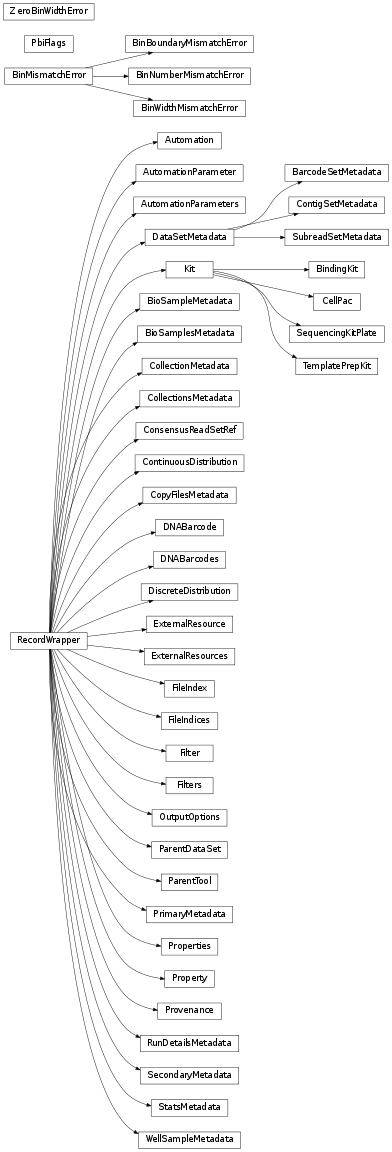
DataSetMetadata (also the tag of the Element in the DataSet XML representation) is somewhat challening to store, access, and (de)serialize efficiently. Here, we maintain a bulk representation of all of the dataset metadata (or any other XML data, like ExternalResources) found in the XML file in the following data structure:
Child elements are represented similarly and stored (recursively) as a list in ‘children’. The top level we store for DataSetMetadata is just a list, which can be thought of as the list of children of a different element (say, a DataSet or SubreadSet element, if we stored that):
- DataSetMetadata = [XmlTag, XmlTagWithSameOrDifferentTag]
We keep this for three reasons:
- We don’t want to have to write a lot of logic to go from XML to an internal representation and then back to XML.
- We want to be able to store and at least write metadata that doesn’t yet exist, even if we can’t merge it intelligently.
- Keeping and manipulating a dictionary is ~10x faster than an OrderedAttrDict, and probably faster to use than a full stack of objects.
Instead, we keep and modify this list:dictionary structure, wrapping it in classes as necessary. The classes and methods that wrap this datastructure serve two pruposes:
- Provide an interface for our code (and making merging clean) e.g.:
- DataSet(“test.xml”).metadata.numRecords += 1
Provide an interface for users of the DataSet API, e.g.:
- numRecords = DataSet(“test.xml”).metadata.numRecords
- bioSamplePointer = (DataSet(“test.xml”) .metadata.collections[0] .wellSample.bioSamplePointers[0])
- Though users can still access novel metadata types the hard way e.g.:
- bioSamplePointer = (DataSet(“test.xml”) .metadata.collections[0] [‘WellSample’][‘BioSamplePointers’] [‘BioSamplePointer’].record[‘text’])
- Notes:
If you want temporary children to be retained for a classes’s children, pass parent=self to the child’s constructor.
- it helps to add a TAG member…
-
class
pbcore.io.dataset.DataSetMembers.Automation(record=None, parent=None)¶ Bases:
pbcore.io.dataset.DataSetMembers.RecordWrapper-
NS= 'pbmeta'
-
automationParameters
-
-
class
pbcore.io.dataset.DataSetMembers.AutomationParameter(record=None)¶ Bases:
pbcore.io.dataset.DataSetMembers.RecordWrapper-
NS= 'pbbase'
-
value
-
-
class
pbcore.io.dataset.DataSetMembers.AutomationParameters(record=None)¶ Bases:
pbcore.io.dataset.DataSetMembers.RecordWrapper-
NS= 'pbbase'
-
__getitem__(tag)¶ Override to use tag as Name instead of strictly tag
-
addParameter(key, value)
-
automationParameter
-
parameterNames
-
-
class
pbcore.io.dataset.DataSetMembers.BarcodeSetMetadata(record=None)¶ Bases:
pbcore.io.dataset.DataSetMembers.DataSetMetadataThe DataSetMetadata subtype specific to BarcodeSets.
-
TAG= 'DataSetMetadata'
-
barcodeConstruction
-
-
exception
pbcore.io.dataset.DataSetMembers.BinBoundaryMismatchError(min1, min2)
-
exception
pbcore.io.dataset.DataSetMembers.BinMismatchError¶ Bases:
exceptions.Exception
-
exception
pbcore.io.dataset.DataSetMembers.BinNumberMismatchError(num1, num2)
-
exception
pbcore.io.dataset.DataSetMembers.BinWidthMismatchError(width1, width2)
-
class
pbcore.io.dataset.DataSetMembers.BindingKit(record=None, parent=None)
-
class
pbcore.io.dataset.DataSetMembers.BioSampleMetadata(record=None, parent=None)¶ Bases:
pbcore.io.dataset.DataSetMembers.RecordWrapperThe metadata for a single BioSample
-
DNABarcodes
-
NS= 'pbsample'
-
TAG= 'BioSample'
-
-
class
pbcore.io.dataset.DataSetMembers.BioSamplesMetadata(record=None, parent=None)¶ Bases:
pbcore.io.dataset.DataSetMembers.RecordWrapperThe metadata for the list of BioSamples
- Doctest:
>>> from __future__ import print_function
>>> from pbcore.io import SubreadSet
>>> import pbcore.data.datasets as data
>>> ds = SubreadSet(data.getSubreadSet(), skipMissing=True)
>>> ds.metadata.collections[0].wellSample.bioSamples[0].name
'consectetur purus'
>>> for bs in ds.metadata.collections[0].wellSample.bioSamples:
...     print(bs.name)
consectetur purus
>>> em = {'tag':'BioSample', 'text':'', 'children':[],
...       'attrib':{'Name':'great biosample'}}
>>> ds.metadata.collections[0].wellSample.bioSamples.append(em)
>>> ds.metadata.collections[0].wellSample.bioSamples[1].name
'great biosample'
-
NS= 'pbsample'
-
TAG= 'BioSamples'
-
__getitem__(index)¶ Get a biosample
-
__iter__()¶ Iterate over biosamples
-
addSample(name)
-
class
pbcore.io.dataset.DataSetMembers.CellPac(record=None, parent=None)¶ Bases:
pbcore.io.dataset.DataSetMembers.Kit-
NS= 'pbmeta'
-
-
class
pbcore.io.dataset.DataSetMembers.CollectionMetadata(record=None, parent=None)¶ Bases:
pbcore.io.dataset.DataSetMembers.RecordWrapperThe metadata for a single collection. It contains Context, InstrumentName etc. as attribs, InstCtrlVer etc. for children
-
NS= 'pbmeta'
-
TAG= 'CollectionMetadata'
-
automation
-
bindingKit
-
cellIndex
-
cellPac
-
collectionNumber
-
consensusReadSetRef
-
context
-
instCtrlVer
-
instrumentId
-
instrumentName
-
primary
-
runDetails
-
secondary
-
sequencingKitPlate
-
sigProcVer
-
templatePrepKit
-
wellSample
-
-
class
pbcore.io.dataset.DataSetMembers.CollectionsMetadata(record=None, parent=None)¶ Bases:
pbcore.io.dataset.DataSetMembers.RecordWrapperThe Element should just have children: a list of CollectionMetadataTags
-
NS= 'pbmeta'
-
TAG= 'Collections'
-
__getitem__(index)¶ Try to get the a specific child (only useful in simple cases where children will not be wrapped in a special wrapper object, returns the first instance of ‘tag’)
-
__iter__()¶ Get each child iteratively (only useful in simple cases where children will not be wrapped in a special wrapper object)
-
merge(other, forceUnique=False)
-
-
class
pbcore.io.dataset.DataSetMembers.ConsensusReadSetRef(record=None, parent=None)¶ Bases:
pbcore.io.dataset.DataSetMembers.RecordWrapper-
uuid
-
-
class
pbcore.io.dataset.DataSetMembers.ContigSetMetadata(record=None)¶ Bases:
pbcore.io.dataset.DataSetMembers.DataSetMetadataThe DataSetMetadata subtype specific to ContigSets.
-
TAG= 'DataSetMetadata'
-
organism
-
ploidy
-
-
class
pbcore.io.dataset.DataSetMembers.ContinuousDistribution(record=None, parent=None)¶ Bases:
pbcore.io.dataset.DataSetMembers.RecordWrapper-
binWidth
-
bins
-
description
-
labels¶ Label the bins with the min value of each bin
-
maxBinValue
-
maxOutlierValue
-
merge(other)
-
minBinValue
-
minOutlierValue
-
numBins
-
sample95thPct
-
sampleMean
-
sampleMed
-
sampleMedian
-
sampleMode
-
sampleSize
-
sampleStd
-
-
class
pbcore.io.dataset.DataSetMembers.CopyFilesMetadata(record=None, parent=None)¶ Bases:
pbcore.io.dataset.DataSetMembers.RecordWrapperThe CopyFile members don’t seem complex enough to justify class representation, instead rely on base class methods
-
TAG= 'CopyFiles'
-
-
class
pbcore.io.dataset.DataSetMembers.DNABarcode(record=None, parent=None)¶ Bases:
pbcore.io.dataset.DataSetMembers.RecordWrapper-
NS= 'pbsample'
-
TAG= 'DNABarcode'
-
-
class
pbcore.io.dataset.DataSetMembers.DNABarcodes(record=None, parent=None)¶ Bases:
pbcore.io.dataset.DataSetMembers.RecordWrapper-
NS= 'pbsample'
-
TAG= 'DNABarcodes'
-
__getitem__(index)¶ Get a DNABarcode
-
__iter__()¶ Iterate over DNABarcode
-
addBarcode(name)
-
-
class
pbcore.io.dataset.DataSetMembers.DataSetMetadata(record=None)¶ Bases:
pbcore.io.dataset.DataSetMembers.RecordWrapperThe root of the DataSetMetadata element tree, used as base for subtype specific DataSet or for generic “DataSet” records.
-
NS= 'pbds'
-
TAG= 'DataSetMetadata'
-
addParentDataSet(uniqueId, metaType, timeStampedName='', createdBy='AnalysisJob')¶ Add a ParentDataSet record in the Provenance section. Currently only used for SubreadSets.
-
merge(other)
-
numRecords¶ Return the number of records in a DataSet using helper functions defined in the base class
-
provenance
-
summaryStats
-
totalLength¶ Return the TotalLength property of this dataset. TODO: update the value from the actual external reference on ValueError
-
-
class
pbcore.io.dataset.DataSetMembers.DiscreteDistribution(record=None, parent=None)¶ Bases:
pbcore.io.dataset.DataSetMembers.RecordWrapper-
bins
-
description
-
labels
-
merge(other)
-
numBins
-
-
class
pbcore.io.dataset.DataSetMembers.ExternalResource(record=None)¶ Bases:
pbcore.io.dataset.DataSetMembers.RecordWrapper-
NS= 'pbbase'
-
adapters
-
addIndices(indices)
-
bai
-
bam
-
barcodes
-
control
-
externalResources
-
gmap¶ Unusual: returns the gmap external resource instead of the resId
-
indices
-
merge(other)
-
metaType
-
pbi
-
reference
-
resourceId
-
scraps
-
sts
-
timeStampedName
-
-
class
pbcore.io.dataset.DataSetMembers.ExternalResources(record=None)¶ Bases:
pbcore.io.dataset.DataSetMembers.RecordWrapper-
NS= 'pbbase'
-
__getitem__(index)¶ Try to get the a specific child (only useful in simple cases where children will not be wrapped in a special wrapper object, returns the first instance of ‘tag’)
-
__iter__()¶ Get each child iteratively (only useful in simple cases where children will not be wrapped in a special wrapper object)
-
addResources(resourceIds)¶ Add a new external reference with the given uris. If you’re looking to add ExternalResource objects, append() or extend() them instead.
- Args:
- resourceIds: a list of uris as strings
-
merge(other)
-
resourceIds
-
resources
-
sort()¶ In theory we could sort the ExternalResource objects, but that would require opening them
-
-
class
pbcore.io.dataset.DataSetMembers.FileIndex(record=None)¶ Bases:
pbcore.io.dataset.DataSetMembers.RecordWrapper-
KEEP_WITH_PARENT= True
-
NS= 'pbbase'
-
metaType
-
resourceId
-
timeStampedName
-
-
class
pbcore.io.dataset.DataSetMembers.FileIndices(record=None)¶ Bases:
pbcore.io.dataset.DataSetMembers.RecordWrapper-
NS= 'pbbase'
-
__getitem__(index)¶ Try to get the a specific child (only useful in simple cases where children will not be wrapped in a special wrapper object, returns the first instance of ‘tag’)
-
__iter__()¶ Get each child iteratively (only useful in simple cases where children will not be wrapped in a special wrapper object)
-
-
class
pbcore.io.dataset.DataSetMembers.Filter(record=None)¶ Bases:
pbcore.io.dataset.DataSetMembers.RecordWrapper-
NS= 'pbds'
-
__getitem__(index)¶ Try to get the a specific child (only useful in simple cases where children will not be wrapped in a special wrapper object, returns the first instance of ‘tag’)
-
__iter__()¶ Get each child iteratively (only useful in simple cases where children will not be wrapped in a special wrapper object)
-
addRequirement(name, operator, value, modulo=None)
-
merge(other)
-
plist
-
pop(index)
-
removeRequirement(req)
-
-
class
pbcore.io.dataset.DataSetMembers.Filters(record=None)¶ Bases:
pbcore.io.dataset.DataSetMembers.RecordWrapper-
NS= 'pbds'
-
__getitem__(index)¶ Try to get the a specific child (only useful in simple cases where children will not be wrapped in a special wrapper object, returns the first instance of ‘tag’)
-
__iter__()¶ Get each child iteratively (only useful in simple cases where children will not be wrapped in a special wrapper object)
-
addFilter(**kwargs)¶ Use this to add filters. Members of the list will be considered requirements for fulfilling this option. Use multiple calls to add multiple filters.
- Args:
- name: The name of the requirement, e.g. ‘rq’ options: A list of (operator, value) tuples, e.g. (‘>’, ‘0.85’)
-
addFilterList(filters)¶ filters is a list of options, with a list of reqs for each option. Each req is a tuple (name, oper, val)
-
addRequirement(**kwargs)¶ Use this to add requirements. Members of the list will be considered options for fulfilling this requirement, all other filters will be duplicated for each option. Use multiple calls to add multiple requirements to the existing filters. Use removeRequirement first to not add conflicting filters.
- Args:
- name: The name of the requirement, e.g. ‘rq’ options: A list of (operator, value) tuples, e.g. (‘>’, ‘0.85’)
-
broadcastFilters(filts)¶ Filt is a list of Filter objects or lists of reqs. Take all existing filters, duplicate and combine with each new filter
-
filterIndexRecords(indexRecords, nameMap, movieMap, readType='bam')
-
fromString(filterString)
-
mapRequirement(**kwargs)¶ Add requirements to each of the existing requirements, mapped one to one
-
merge(other)
-
removeFilter(index)
-
removeRequirement(req)
-
testCompatibility(other)
-
testField(param, values, testType=<type 'str'>, oper='=')
-
testParam(param, value, testType=<type 'str'>, oper='=')
-
tests(readType='bam', tIdMap=None)
-
-
class
pbcore.io.dataset.DataSetMembers.Kit(record=None, parent=None)¶ Bases:
pbcore.io.dataset.DataSetMembers.RecordWrapper-
barcode
-
expirationDate
-
lotNumber
-
partNumber
-
-
class
pbcore.io.dataset.DataSetMembers.OutputOptions(record=None, parent=None)¶ Bases:
pbcore.io.dataset.DataSetMembers.RecordWrapper-
NS= 'pbmeta'
-
collectionPathUri
-
copyFiles
-
resultsFolder
-
-
class
pbcore.io.dataset.DataSetMembers.ParentDataSet(record=None, parent=None)¶ Bases:
pbcore.io.dataset.DataSetMembers.RecordWrapper-
NS= 'pbds'
-
metaType
-
timeStampedName
-
-
class
pbcore.io.dataset.DataSetMembers.ParentTool(record=None, parent=None)¶ Bases:
pbcore.io.dataset.DataSetMembers.RecordWrapper-
NS= 'pbds'
-
-
class
pbcore.io.dataset.DataSetMembers.PbiFlags¶ Bases:
object-
ADAPTER_AFTER= 2
-
ADAPTER_BEFORE= 1
-
BARCODE_AFTER= 8
-
BARCODE_BEFORE= 4
-
FORWARD_PASS= 16
-
NO_LOCAL_CONTEXT= 0
-
REVERSE_PASS= 32
-
classmethod
flagMap(flag)
-
-
class
pbcore.io.dataset.DataSetMembers.PrimaryMetadata(record=None, parent=None)¶ Bases:
pbcore.io.dataset.DataSetMembers.RecordWrapper- Doctest:
>>> import os, tempfile
>>> from pbcore.io import SubreadSet
>>> import pbcore.data.datasets as data
>>> ds1 = SubreadSet(data.getXml(5), skipMissing=True)
>>> ds1.metadata.collections[0].primary.outputOptions.resultsFolder
'Analysis_Results'
>>> ds1.metadata.collections[0].primary.outputOptions.resultsFolder = (
...     'BetterAnalysis_Results')
>>> ds1.metadata.collections[0].primary.outputOptions.resultsFolder
'BetterAnalysis_Results'
>>> outdir = tempfile.mkdtemp(suffix="dataset-doctest")
>>> outXml = 'xml:' + os.path.join(outdir, 'tempfile.xml')
>>> ds1.write(outXml, validate=False)
>>> ds2 = SubreadSet(outXml, skipMissing=True)
>>> ds2.metadata.collections[0].primary.outputOptions.resultsFolder
'BetterAnalysis_Results'
-
NS= 'pbmeta'
-
TAG= 'Primary'
-
automationName
-
configFileName
-
outputOptions
-
sequencingCondition
-
class
pbcore.io.dataset.DataSetMembers.Properties(record=None)¶ Bases:
pbcore.io.dataset.DataSetMembers.RecordWrapper-
NS= 'pbbase'
-
__getitem__(index)¶ Try to get the a specific child (only useful in simple cases where children will not be wrapped in a special wrapper object, returns the first instance of ‘tag’)
-
__iter__()¶ Get each child iteratively (only useful in simple cases where children will not be wrapped in a special wrapper object)
-
merge(other)
-
-
class
pbcore.io.dataset.DataSetMembers.Property(record=None)¶ Bases:
pbcore.io.dataset.DataSetMembers.RecordWrapper-
NS= 'pbbase'
-
hashfunc
-
modulo
-
name
-
operator
-
value
-
-
class
pbcore.io.dataset.DataSetMembers.Provenance(record=None, parent=None)¶ Bases:
pbcore.io.dataset.DataSetMembers.RecordWrapperThe metadata concerning this dataset’s provenance
-
NS= 'pbds'
-
addParentDataSet(uniqueId, metaType, timeStampedName)
-
createdBy
-
parentDataSet
-
parentTool
-
-
class
pbcore.io.dataset.DataSetMembers.RecordWrapper(record=None, parent=None)¶ Bases:
objectThe base functionality of a metadata element.
Many of the methods here are intended for use with children of RecordWrapper (e.g. append, extend). Methods in child classes often provide similar functionality for more raw inputs (e.g. resourceIds as strings)
-
KEEP_WITH_PARENT= False
-
NS= ''
-
__getitem__(tag)¶ Try to get the a specific child (only useful in simple cases where children will not be wrapped in a special wrapper object, returns the first instance of ‘tag’)
-
__iter__()¶ Get each child iteratively (only useful in simple cases where children will not be wrapped in a special wrapper object)
-
__repr__()¶ Return a pretty string represenation of this object:
“<type tag text attribs children>”
-
addMetadata(key, value)¶ Add a key, value pair to this metadata object (attributes)
-
append(newMember)¶ Append to the actual list of child elements
-
attrib
-
clearCallbacks()
-
createdAt
-
description
-
extend(newMembers)¶ Extend the actual list of child elements
-
findChildren(tag)
-
getMemberV(tag, container='text', default=None, asType=<type 'str'>, attrib=None)¶ Generic accessor for the contents of the children of this element, without having to interface with them directly
-
getV(container='text', tag=None)¶ Generic accessor for the contents of this element’s ‘attrib’ or ‘text’ fields
-
index(tag)¶ Return the index in ‘children’ list of item with ‘tag’ member
-
merge(other)
-
metadata¶ Cleaner accessor for this node’s attributes. Returns mutable, doesn’t need setter
-
metaname¶ Cleaner accessor for this node’s tag
-
metavalue¶ Cleaner accessor for this node’s text
-
name
-
namespace
-
pop(index)
-
pruneChildrenTo(whitelist)
-
registerCallback(func)
-
removeChildren(tag)
-
setMemberV(tag, value, container='text', attrib=None)¶ Generic accessor for the contents of the children of this element, without having to interface with them directly
-
setV(value, container='text', tag=None)¶ Generic accessor for the contents of this element’s ‘attrib’ or ‘text’ fields
-
submetadata¶ Cleaner accessor for wrapped versions of this node’s children.
-
subrecords¶ Cleaner accessor for this node’s children. Returns mutable, doesn’t need setter
Return the list of tags for children in this element
-
text
-
uniqueId
-
value
-
version
-
-
class
pbcore.io.dataset.DataSetMembers.RunDetailsMetadata(record=None, parent=None)¶ Bases:
pbcore.io.dataset.DataSetMembers.RecordWrapper-
NS= 'pbmeta'
-
TAG= 'RunDetails'
-
name
-
timeStampedName
-
-
class
pbcore.io.dataset.DataSetMembers.SecondaryMetadata(record=None, parent=None)¶ Bases:
pbcore.io.dataset.DataSetMembers.RecordWrapper-
TAG= 'Secondary'
-
cellCountInJob
-
-
class
pbcore.io.dataset.DataSetMembers.SequencingKitPlate(record=None, parent=None)
-
class
pbcore.io.dataset.DataSetMembers.StatsMetadata(record=None, parent=None)¶ Bases:
pbcore.io.dataset.DataSetMembers.RecordWrapperThe metadata from the machine sts.xml
-
CHANNEL_DISTS= ['BaselineLevelDist', 'BaselineStdDist', 'SnrDist', 'HqRegionSnrDist', 'HqBasPkMidDist', 'BaselineLevelSequencingDist', 'TotalBaseFractionPerChannel', 'DmeAngleEstDist']
-
MERGED_DISTS= ['ProdDist', 'ReadTypeDist', 'ReadLenDist', 'ReadQualDist', 'MedianInsertDist', 'InsertReadQualDist', 'InsertReadLenDist', 'ControlReadQualDist', 'ControlReadLenDist']
-
OTHER_DISTS= ['PausinessDist', 'PulseRateDist', 'PulseWidthDist', 'BaseRateDist', 'BaseWidthDist', 'BaseIpdDist', 'LocalBaseRateDist', 'NumUnfilteredBasecallsDist', 'HqBaseFractionDist', 'NumUnfilteredBasecallsDist']
-
UNMERGED_DISTS= ['BaselineLevelDist', 'BaselineStdDist', 'SnrDist', 'HqRegionSnrDist', 'HqBasPkMidDist', 'BaselineLevelSequencingDist', 'TotalBaseFractionPerChannel', 'DmeAngleEstDist', 'PausinessDist', 'PulseRateDist', 'PulseWidthDist', 'BaseRateDist', 'BaseWidthDist', 'BaseIpdDist', 'LocalBaseRateDist', 'NumUnfilteredBasecallsDist', 'HqBaseFractionDist', 'NumUnfilteredBasecallsDist']
-
__getitem__(key)¶ Try to get the a specific child (only useful in simple cases where children will not be wrapped in a special wrapper object, returns the first instance of ‘tag’)
-
adapterDimerFraction
-
availableDists()
-
channelDists¶ This can be modified to use the new accessors above instead of the brittle list of channel dists above
-
controlReadLenDist
-
controlReadQualDist
-
getDist(key, unwrap=True)
-
insertReadLenDist
-
insertReadLenDists
-
insertReadQualDist
-
insertReadQualDists
-
medianInsertDist
-
medianInsertDists
-
merge(other)¶ This can be modified to use the new accessors above instead of the brittle list of dists above
-
numSequencingZmws
-
otherDists¶ This can be modified to use the new accessors above instead of the brittle list of dists above
-
prodDist
-
readLenDist
-
readLenDists
-
readQualDist
-
readQualDists
-
readTypeDist
-
shortInsertFraction
-
-
class
pbcore.io.dataset.DataSetMembers.SubreadSetMetadata(record=None)¶ Bases:
pbcore.io.dataset.DataSetMembers.DataSetMetadataThe DataSetMetadata subtype specific to SubreadSets. Deals explicitly with the merging of Collections metadata hierarchies.
-
TAG= 'DataSetMetadata'
-
collections¶ Return a list of wrappers around Collections elements of the Metadata Record
-
getMovieSampleNames()¶ Map the BioSample names in metadata Collection to “context” ID, i.e. movie names. Used for deconvoluting multi-sample inputs. This function will raise a KeyError if a movie name is not unique, or a ValueError if there is not a 1-to-1 mapping of sample to to movie.
-
merge(other)
-
-
class
pbcore.io.dataset.DataSetMembers.TemplatePrepKit(record=None, parent=None)¶ Bases:
pbcore.io.dataset.DataSetMembers.KitTemplatePrepKit metadata
-
leftAdaptorSequence
-
rightAdaptorSequence
-
-
class
pbcore.io.dataset.DataSetMembers.WellSampleMetadata(*args, **kwargs)¶ Bases:
pbcore.io.dataset.DataSetMembers.RecordWrapper-
NS= 'pbmeta'
-
TAG= 'WellSample'
-
bioSamples
-
comments
-
concentration
-
sampleReuseEnabled
-
sizeSelectionEnabled
-
stageHotstartEnabled
-
useCount
-
wellName
-
-
exception
pbcore.io.dataset.DataSetMembers.ZeroBinWidthError(width1, width2)¶ Bases:
exceptions.Exception
-
pbcore.io.dataset.DataSetMembers.accs(key, container='attrib', asType=<function <lambda>>, parent=False)
-
pbcore.io.dataset.DataSetMembers.breakqname(qname)
-
pbcore.io.dataset.DataSetMembers.filter_read(accessor, operator, value, read)
-
pbcore.io.dataset.DataSetMembers.fromFile(value)
-
pbcore.io.dataset.DataSetMembers.getter(key, container='attrib', asType=<function <lambda>>, parent=False)
-
pbcore.io.dataset.DataSetMembers.histogram_percentile(counts, labels, percentile)
-
pbcore.io.dataset.DataSetMembers.inNd(arrs1, arrs2)
-
pbcore.io.dataset.DataSetMembers.isFile(string)
-
pbcore.io.dataset.DataSetMembers.isListString(string)¶ Detect if string is actually a representation a stringified list
-
pbcore.io.dataset.DataSetMembers.make_mod_hash_acc(accessor, mod, hashname)
-
pbcore.io.dataset.DataSetMembers.mapOp(op)
-
pbcore.io.dataset.DataSetMembers.map_val_or_vec(func, target)
-
pbcore.io.dataset.DataSetMembers.n_subreads(index)
-
pbcore.io.dataset.DataSetMembers.newUuid(record)
-
pbcore.io.dataset.DataSetMembers.qname2vec(qnames)
-
pbcore.io.dataset.DataSetMembers.qnamer(qid2mov, qId, hn, qs, qe)
-
pbcore.io.dataset.DataSetMembers.runonce(func)
-
pbcore.io.dataset.DataSetMembers.setify(value)
-
pbcore.io.dataset.DataSetMembers.setter(key, container='attrib')
-
pbcore.io.dataset.DataSetMembers.str2list(value)
-
pbcore.io.dataset.DataSetMembers.subaccs(key, container='text', default=None, asType=<function <lambda>>, attrib=None)
-
pbcore.io.dataset.DataSetMembers.subgetter(key, container='text', default=None, asType=<function <lambda>>, attrib=None)
-
pbcore.io.dataset.DataSetMembers.subsetter(key, container='text', attrib=None)
-
pbcore.io.dataset.DataSetMembers.updateNamespace(ele, ns)
-
pbcore.io.dataset.DataSetMembers.updateTag(ele, tag)
-
pbcore.io.dataset.DataSetMembers.uri2fn(fn)
-
pbcore.io.dataset.DataSetMembers.uri2scheme(fn)